ubo
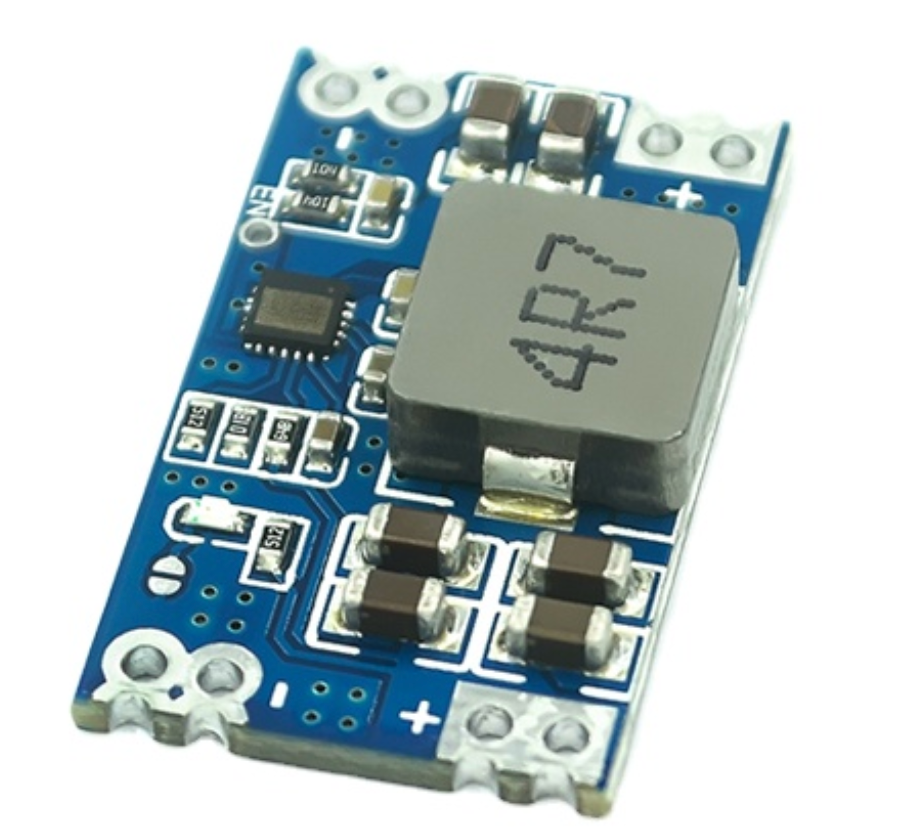
MINI560 Synchronous Buck Converter — 3.3V / 5A Step-Down Module
MINI560 Synchronous Buck Converter — 3.3V / 5A Step-Down Module
Couldn't load pickup availability
The MINI560 is a compact, high-efficiency DC-DC step-down module built around a JoulWatt JW5069A synchronous buck regulator in a tiny QFN-20 (3×3mm) package. Unlike older asynchronous regulators, synchronous rectification delivers up to 95% efficiency, meaning less wasted power, lower heat, and a smaller footprint for the same load.
Running at a 500 kHz switching frequency, the module keeps output ripple tight while using minimal board space — ideal for embedding in projects where every millimeter counts.
Specifications
- Regulator IC: JoulWatt JW5069A (synchronous buck, QFN-20 3×3mm)
- Input voltage: 4V – 23V DC
- Output voltage: 3.3V (factory-set)
- Output current: up to 5A continuous
- Switching frequency: ~500 kHz
- Efficiency: up to 95%
- Topology: non-isolated synchronous buck
- Operating temperature: -40°C to +85°C
- Dimensions: 30 × 18 × 5.4 mm
- Weight: 5.5 g
Adjustable on demand — the output is set by 0603 1% feedback resistors, so the 3.3V rail can be reconfigured by experienced users if needed.
Typical applications
- Powering 3.3V microcontrollers, sensors, and embedded systems
- Stepping down battery packs (2S–5S Li-ion, 12V/24V rails)
- Communication and wireless modules
- General-purpose 3.3V supply for electronics projects
In the box: 1 × MINI560 3.3V/5A Synchronous Buck Module
Adjustable output (advanced) — The output voltage is set by a single 0603 1% feedback resistor. Experienced users can change the output rail by swapping this resistor to one of the following values:
| Output Voltage | Resistor Value | Size | Marking Code |
|---|---|---|---|
| 3.3V (this module) | 4.53 kΩ / 1% | 0603 | 64B |
| 5.0V | 7.5 kΩ / 1% | 0603 | 85B |
| 9.0V | 14.3 kΩ / 1% | 0603 | 16C |
| 12V | 19.1 kΩ / 1% | 0603 | 28C |
Note: changing the feedback resistor adjusts the output voltage only — always stay within the module's 4–23V input range and 5A output limit, and ensure the target voltage is below (input − ~1.5V) for proper regulation.
For more in-depth analysis of this module, checkout the article below: